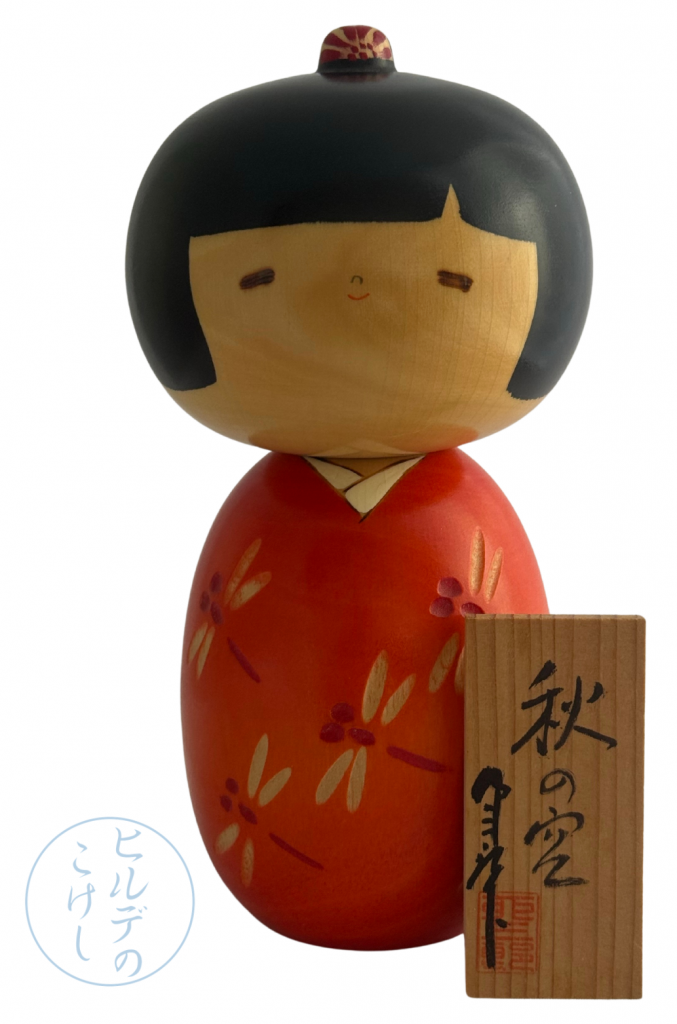
This lovely kokeshi by Okamoto Yoshie (秋の空) is called Aki no sora which means Autumn Sky, which undoubtedly refers to her orange kimono with dragonflies, tombo or tombo (蜻蛉).
In Japanese culture, the colour orange carries highly positive, sacred associations. It represents love, happiness, courage, and good health. Historically, it signifies knowledge and civilization, and is commonly tied to the warmth of the sun and the autumn harvest.
Beyond symbolism, orange plays several prominent functional and religious roles in Japan:
- You will frequently see a vibrant, orange-red hue called shuiro (朱色) painting Shinto shrines and Buddhist temples. In Shinto, this distinct colour signifies divine presence, protects sacred spaces from evil spirits, and historically helped preserve wooden structures from weathering and insects.
- The traditional Japanese word for the colour orange before Western influence was daidai (橙色 / だいだいいろ). It gets its name from the bitter orange fruit of the same name. Because the word daidai also sounds like the word for “generation to generation,” the fruit is a major New Year’s decoration, symbolising family prosperity, longevity, and good fortune.
- Historically, the perception of orange was tied to the social hierarchy. A rich orange (ōtan) was strictly reserved for the Crown Prince, making it one of the highest and most coveted colours in the Imperial court.
In the modern context, learning the traditional kanji like daidai (橙) or the borrowed Western loanword orenji (オレンジ / オレンジ色) offers a deeper look into Japan’s history with the sun and nature.
The dragonfly is a classic symbol of late summer and autumn in Japan. It is famously immortalised in the beloved 1927 Japanese children’s song “Akatombo” – 赤蜻蛉 – (Red Dragonfly), which evokes deep nostalgia and childhood memories.
The kanji for tombo (蜻蛉) is a complex compound word made of two characters that both mean dragonfly on their own. It is a classic example of jukujikuny (熟字訓), where the kanji are chosen specifically for the meaning of the word rather than their individual phonetic readings.
Historically, dragonflies were called kachimushi – 勝虫 (victory insect) – by the samurai, as dragonflies symbolise courage and agility. Because of their swift flight, predatory prowess, and habit of relentlessly darting forward, samurai adopted dragonflies as emblems of fearlessness and military success. Warriors often decorated their armour, sword hilts (tsuka – 柄), and arrow quivers with dragonfly motifs. Samurai favoured the dragonfly because it flies swiftly forward to attack its prey but never flies backward. This behaviour perfectly mirrored the samurai ideal of relentless determination, fearlessness, and refusal to retreat in battle.
Cultural significance:
- Dragonflies hold a deep cultural meaning in Japan, where the creature is associated with agility, courage, and transformation. Historically, dragonflies were revered by swordsmen for their swift, aggressive flight, and mythological origins even suggest in the 8th-century chronicle Kojiki (古事記), Japan was once referred to as Akitsushima, 秋津島 (Dragonfly Island). Legend states that the mythic Emperor Jimmu (神武) looked down upon the landscape and noted that the islands resembled a pair of mating dragonflies. Another legend says Emperor Yuryaku (雄略) was saved from a biting horsefly when a dragonfly swooped down and ate it, cementing the insect as a protective, lucky warrior ally.
- During the summer festival of Obon (お盆), dragonflies are widely believed to carry the souls of ancestors back to the earthly realm.
Specification:
Height: 17 centimetres